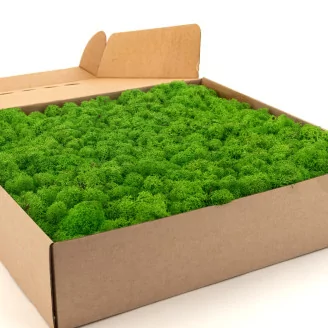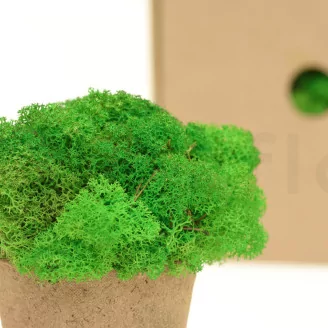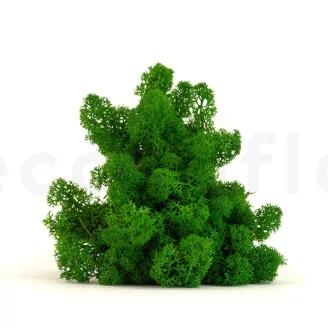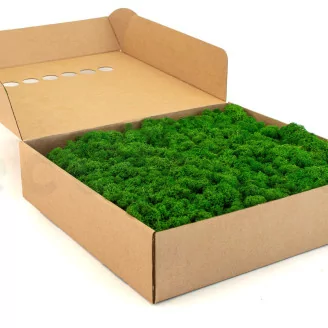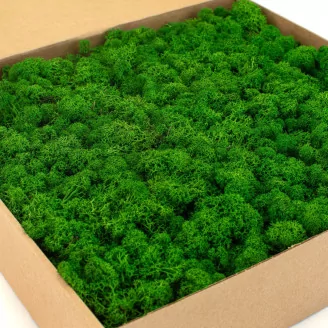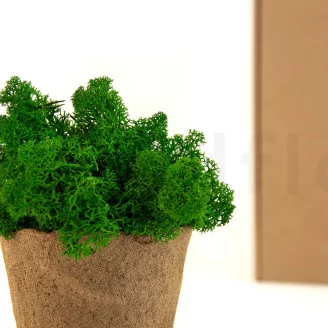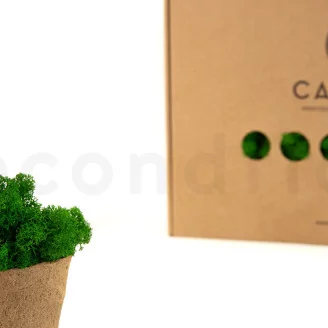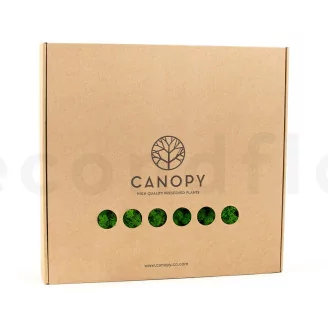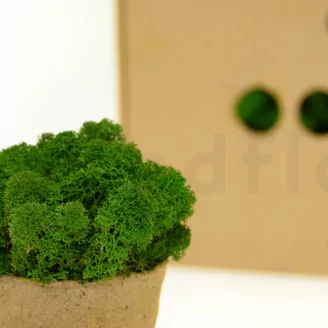


Reindeer moss is harvested in the heart of Scandinavian landscapes, where it is the main food of the reindeer that gave it its name. Preserved reindeer moss is one of our bestsellers: it is the go-to material for moss walls and biophilic design, and one of the oldest preserved plants.
What does reindeer moss look like before it is preserved?
In its natural state, reindeer moss is a very dry and brittle plant. During its harvest, it is not uncommon to see long hoses being deployed to humidify it. This allows it to be handled in crates and transported without damaging it. Despite this “dry” appearance, it is also very spongy, like sphagnum moss. The latter originates from the natural peat bogs of Chile, and is used to make exterior green walls.
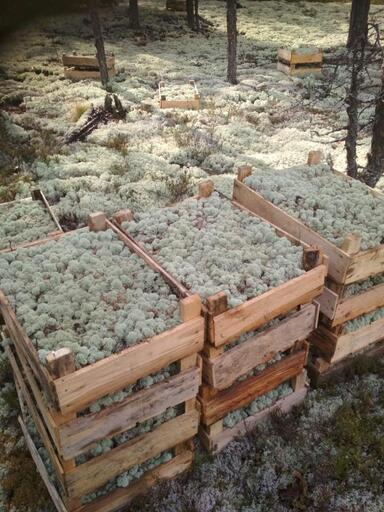
How is reindeer moss preserved?
Reindeer moss is the only plant that is not preserved with glycerin. It is preserved with salt using the preservation by immersion technique. It is immersed in a saline solution (food coloring), then cleaned and dried.
How does reindeer moss obtain its multiple colors?
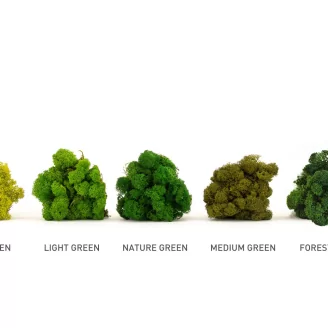
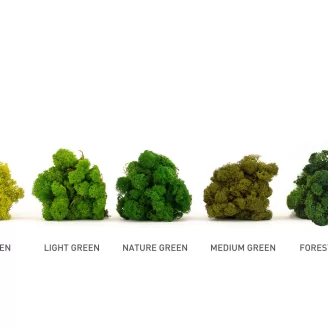
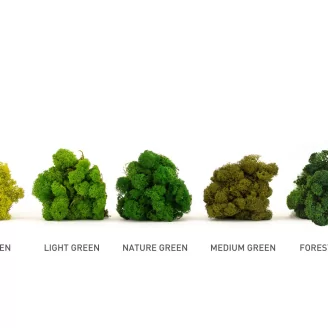
As you saw in the picture above, reindeer moss is originally white. Thanks to the preservation process, preserved reindeer moss exists in a multitude of colors. Of course, fans of biophilic design will appreciate the various green shades, but the more adventurous among you will love the bold colors we offer such as red, purple, and so on. From the most daring to the most popular, these different colors can adapt to all types of plant projects.
What are the advantages and the constraints when using reindeer moss for your business?
Unlike glycerin, the saline solution is non-flammable, which gives it a natural fireproof property. Moreover, this process allows a natural treatment against insects. Finally, this technique is cheaper than glycerin preservation preservation by immersion, while being able to certify that the plants thus preserved are the most reliable of all.
Despite these advantages, below 40% humidity, reindeer moss becomes dry and brittle again. As salt does not work like glycerin, it needs a minimum of surrounding humidity to be able to drink water and keep its fresh look. Below 40% humidity, salt no longer has enough water to capture.
Fire rating: ASTM E84 Class I
Our preserved reindeer moss is certified ASTM E84 Class I (also called Class A), the highest flame spread rating of the US standard used for interior finishes. This is often what architects, designers and building managers ask for before approving a moss wall in a hotel, an office or any public space.
See all our fire-rated preserved moss and artificial plants.
A final word?
In addition to being the most reliable of all preserved plants, reindeer moss is now a true decorative element on its own. It is ideal for the construction of plant walls. In particular, it has high-performance acoustic attenuation properties, particularly suitable for public places and open-space offices.