
WHAT IS IT?
Japanese Floral Art: A Guide to Ikebana and Beyond
Japanese floral art is far more than "flowers in a vase." It is a family of disciplines, each shaped by Buddhism, the tea ceremony, the turning of the seasons and a deep respect for nature. Ikebana is the most famous of them, but it is not the only one: moss-ball kokedama, the restrained flowers of the tea room, pressed-flower pictures and silk flowers folded with tweezers all belong to the same tradition.
In this guide, we look at what makes Japanese floral art so distinctive, walk through the main ikebana styles, explore lesser-known techniques, and show you how to recreate the look with preserved flowers and moss — designs that keep their line and color for months, with no water and no daily care. Ideal for florists, event designers and hospitality venues that want the serenity of Japan without the upkeep of fresh stems.
Ikebana: the heart of Japanese floral art
Ikebana (生け花) combines ikeru, "to keep alive," and hana, "flower." It is also called kadō, "the way of flowers," and is considered one of Japan's three classical arts of refinement, alongside the tea ceremony and kōdō, the art of incense.
The art grew out of floral offerings placed before Buddhist altars. In the 15th century, the priest Ikenobō Senkei codified its first formal style in Kyoto, and over the following centuries ikebana spread from temples to every level of Japanese society. The 20th century opened it to Western flowers, modern containers and free expression.
Today there are around 3,000 ikebana schools in Japan, from Ikenobō, the oldest, to Sōgetsu, known for its contemporary, free-form approach.
The core principles
Whatever the school, a few ideas set ikebana apart from Western floral design:
- Three main lines. Most arrangements are built on three stems, usually called shin, soe and hikae (some schools say tai for the third). Shin is the tallest, soe is mid-height and angled, hikae is the shortest. Schools assign them slightly different meanings, but together they stand for heaven, earth and humankind.
- Ma, or empty space. Space is not something to fill; it is part of the composition. The emptiness around a branch gives it presence.
- Asymmetry. Ikebana avoids the round, symmetrical mass of a Western bouquet. Balance comes from tension between uneven lines.
- Line over volume. Stems, branches and leaves matter as much as the blooms. A bare twig can be the star.
- Seasonality. An arrangement should evoke a specific moment of the year: a budding branch in spring, grasses in autumn.
- Wabi-sabi. Imperfection, asymmetry and the beauty of things that fade are celebrated rather than hidden.
The main ikebana styles
| Style | Meaning | What it looks like |
|---|---|---|
| Rikka (立花) | "Standing flowers" | The oldest, most formal style: a miniature landscape in a tall vase |
| Shōka / Seika (生花) | "Living flowers" | A pared-down rikka: one to three materials, three main stems |
| Nageire (投入) | "Thrown in" | Natural, unforced stems in a tall, narrow vase, without a pin frog |
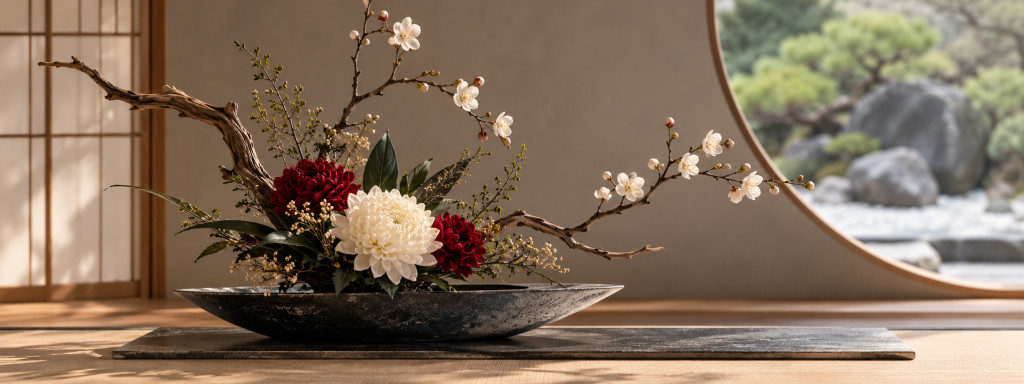
| Moribana (盛花) | "Piled-up flowers" | Stems on a kenzan in a shallow dish; the best style for beginners |
| Jiyūka (自由花) | "Free style" | Any material, as long as the season is expressed |
| Chabana (茶花) | "Tea flowers" | The understated flowers of the tea room, often a single bloom |
Beyond ikebana: other forms of Japanese floral art
Ikebana is the best-known form of Japanese floral art, but Japan’s floral culture is much broader. These techniques are great sources of inspiration for designers looking for something different.
Kokedama: the moss-ball garden
Kokedama (苔玉, literally "moss ball") wraps a plant's root ball in soil and moss, bound with string. The ball can sit on driftwood or bark, rest in a glass dish, or hang in mid-air. Rooted in Japanese garden culture, it has become a favorite of modern interior design for its sculptural, minimalist look.
Oshibana: pictures made of pressed flowers
Oshibana (押し花) means "pressed flowers". Practiced as an art since around the 16th century, it uses dried petals, leaves and stems to compose pictures, often landscapes or seasonal scenes, framed like paintings.
Tsumami zaiku: flowers folded from silk
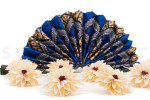
Tsumami zaiku (つまみ細工), the "pinching craft," dates back to the Edo period, roughly 200 years ago. Artisans cut thin silk into tiny squares and fold each one with tweezers into a petal: rounded folds (maru-tsumami) for soft blooms, pointed folds for sharp ones. The petals are then assembled into chrysanthemums, plum blossoms or cherry blossoms.
The craft reportedly began as a way to reuse leftover kimono fabric, in the spirit of mottainai (avoiding waste). It is best known for kanzashi hair ornaments worn at milestones such as Shichi-Go-San and Coming-of-Age Day, and is recognized as a traditional craft by the Tokyo Metropolitan Government.
Hanakotoba: the language of flowers
Like Victorian floriography, hanakotoba (花言葉, "flower words") gives each flower a meaning. It informs the choice of blooms in ikebana, gifts and even kimono patterns. Some of the most cited meanings:
| Flower | Japanese name | Meaning in hanakotoba |
|---|---|---|
| Cherry blossom | Sakura (桜) | Kindness, gentleness, the transience of life; Japan's emblematic spring flower |
| Chrysanthemum | Kiku (菊) | Nobility; yellow is linked to the Imperial family, white to truth |
| Red camellia | Aka tsubaki (赤椿) | Being in love |
| Carnation | Kānēshon | Fascination, distinction, love |
| Daffodil | Suisen (水仙) | Respect |
| Wisteria | Fuji (藤) | Elegance and loyalty (traditional meaning) |
| Lotus | Hasu (蓮) | Purity: a white flower that rises from the mud |
The chrysanthemum holds a special place: it appears on the Imperial crest and is celebrated at the Chrysanthemum Festival (Chōyō no sekku) each autumn — a perfect theme for a fall display.
Japanese floral art in the United States
America has a special connection to ikebana. In 1956, Ellen Gordon Allen, an American living in Tokyo with her husband, a U.S. Army officer, founded Ikebana International under the motto "Friendship through Flowers." Back in Washington, D.C., she created its first chapter outside Japan, Chapter No. 1, which still holds an annual exhibition at the U.S. National Arboretum.
The friendship flowed both ways. In 1965, echoing Japan's famous gift of cherry trees to Washington, Ikebana International chapters in the U.S. offered 150 dogwood saplings to the City of Tokyo.
Today the organization counts 138 chapters in 44 countries, with many active groups across the U.S. that host demonstrations, workshops and exhibitions. Local chapters and school-affiliated teachers (Ikenobō, Ohara, Sōgetsu) are the best way to take lessons near you.
Japanese floral art with preserved flowers
Traditional ikebana celebrates the ephemeral: a fresh arrangement lives a few days, and that is part of its meaning. Purists will always work with fresh stems. But for a hotel lobby, a restaurant, a spa, a retail window or a client's home, an arrangement that wilts within the week is hard to sustain.
Preserved flowers offer a middle path. They are real flowers and plants whose sap has been replaced by a plant-based preservation solution, so they stay supple and colorful for months, even years, with no water, no light and no maintenance. You keep the natural texture and the line of real botanicals, which is exactly what Japanese design is about.
A few precautions: preserved botanicals are for indoor use, away from direct sunlight, heat sources and high humidity. Don't mist or water them.
How to make a preserved moribana arrangement, step by step
Moribana is the easiest style to start with, and it adapts perfectly to preserved materials.
What you need:
- A shallow dish or suiban, in ceramic, stone or dark wood
- A kenzan (pin frog), or a foam-free alternative: a block of wood drilled with holes, crumpled chicken wire or a dry base hidden under moss
- One line material: preserved branches, preserved eucalyptus or preserved grasses
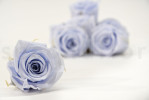
- One or two focal flowers: preserved chrysanthemums, preserved orchids, preserved hydrangeas or preserved roses
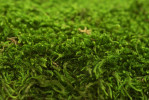
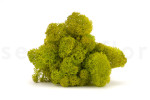
- Preserved forest moss or preserved reindeer moss to hide the mechanics
- Floral wire and stem tape, sharp shears
The steps:
- Choose your season and your message. Decide what moment the piece should evoke, and pick flowers using hanakotoba: chrysanthemums for an autumn piece about nobility, carnations for a gift about admiration.
- Prepare the stems. Preserved flowers are often sold as heads. Insert a floral wire into the base of each head, bend it down along a natural stem or a twig, and wrap with stem tape so it looks organic.
- Place shin, the main line. A common rule of thumb: shin measures 1.5 to 2 times the width plus the depth of your container. Insert it toward the back left, leaning slightly forward, about 10 to 15° from vertical.
- Add soe, the secondary line. About three-quarters the length of shin, placed in front of it and angled around 45° to the side.
- Add hikae, the third line. About three-quarters the length of soe, angled low toward the front, around 75°. Your three tips should form an uneven triangle.
- Add a few supporting stems (jushi). Keep them shorter than the main lines and resist the urge to fill. Each new stem must earn its place.
- Hide the base. Cover the kenzan or the holder with preserved moss or reindeer moss, leaving part of the dish visible: in a traditional moribana, the empty surface evokes water.
- Step back and edit. Look from the front, at eye level. If in doubt, remove a stem. Ma, the empty space, is what makes the piece Japanese.
More preserved ideas inspired by Japan
- A preserved kokedama. Wrap a foam or wooden ball in preserved sheet moss, bind it with fine twine or fishing line, and top it with a preserved orchid or a small cluster of flowers. Hang several at different heights for a striking window display, with zero watering.
- A chabana-style accent. A single preserved orchid stem or camellia-like bloom with one leaf, in a narrow bamboo or ceramic vase. Perfect for reception desks, restaurant tables and hotel rooms where space is limited.
- A seasonal tokonoma corner. Create a niche or shelf with a scroll, a stone and a small arrangement, and change the flowers four times a year: soft pink hydrangeas evoking sakura in spring, green grasses in summer, chrysanthemums and amaranth in autumn, white gypsophila and branches in winter.
- An oshibana-inspired frame. Arrange preserved petals and preserved leaves in a deep shadow-box frame to compose a landscape or a single branch. A meaningful, long-lasting gift.
- A zen moss wall or tray. Combine preserved pole moss, reindeer moss and a few stones in a long, low tray or a framed panel: a contemplative miniature garden, ideal for spas and wellness spaces.
- Japanese-inspired wedding décor. Low asymmetric centerpieces, single-stem table accents and cascading nageire designs on the welcome table. Made with preserved flowers, they can be prepared weeks ahead and kept by the couple.
FAQ about Japanese floral art
What is Japanese floral art called?
The best-known form is ikebana, also called kadō, "the way of flowers." Other Japanese floral arts include chabana (tea-room flowers), kokedama (moss balls), oshibana (pressed-flower pictures) and tsumami zaiku (folded silk flowers).
How is ikebana different from Western flower arranging?
Western arrangements tend to be full, round and symmetrical, focused on the blooms. Ikebana is asymmetrical, uses fewer materials, gives as much importance to stems and branches as to flowers, and treats empty space as part of the design.
What are the three main stems in ikebana?
Shin (the tallest), soe (the middle line) and hikae or tai (the shortest). Together they are traditionally associated with heaven, earth and humankind.
Can you make ikebana with preserved or dried flowers?
Yes. Traditionalists favor fresh, living materials, but contemporary and free-style ikebana welcome any material. Preserved flowers keep the natural look and line of real plants and last for months without water, which makes them ideal for commercial spaces and events.
What is a kenzan?
A heavy metal base covered with sharp pins that holds stems in place, also called a pin frog or needlepoint holder. It is the essential tool of the moribana style.
Which flowers are most typical of Japanese floral art?
Cherry blossoms, chrysanthemums, camellias, plum blossoms, irises and wisteria, along with branches, grasses and moss. Choose them according to the season and their meaning in hanakotoba.
Create your own Japanese-inspired designs
From a single chabana stem to a full moribana or a hanging kokedama, Japanese floral art is a lesson in restraint: fewer stems, more intention. Explore our preserved flowers, preserved foliage and preserved moss on SecondFlor.us to build lasting designs for your clients, your venue or your next event.